Is Bergen Expensive for Food?
Why coffee, a sandwich and a fast-food meal are one question
People search for all three separately and they have the same answer. Groceries sit at a reduced tax rate; a restaurant meal sits at the standard rate. The moment a person makes something and hands it to you across a counter, two things load onto it: that person’s wage, paid in full because there is no tipping culture subsidising it, and the higher rate. That is why the ranking is always the same — packaged from a shop, then something assembled at a counter, then something brought to a table — and why the jump between the first and the last is much bigger here than it is at home. The structure behind it.
The things that genuinely cost nothing
Tap water is safe, good and free, and asking for it in a restaurant is entirely normal — the city runs six treatment plants, takes around 1,500 samples a year across the network and tests for more than sixty substances. Nobody is waiting for a tip: service is not charged separately and staff are on full wages, so the figure on the bill is the figure. And the walking is free, which in a city this compact matters more than it sounds. Drinking the tap water · Tipping, without a percentage.
Where travellers overspend
Alcohol is the sharpest single line. Anything above 4.7% ABV is sold only through the state monopoly, Vinmonopolet, which is closed on Sundays and public holidays; beer up to that strength is in ordinary shops but within national time limits. A drink bought in a bar carries all of the above plus the wage. Buying alcohol in Bergen.
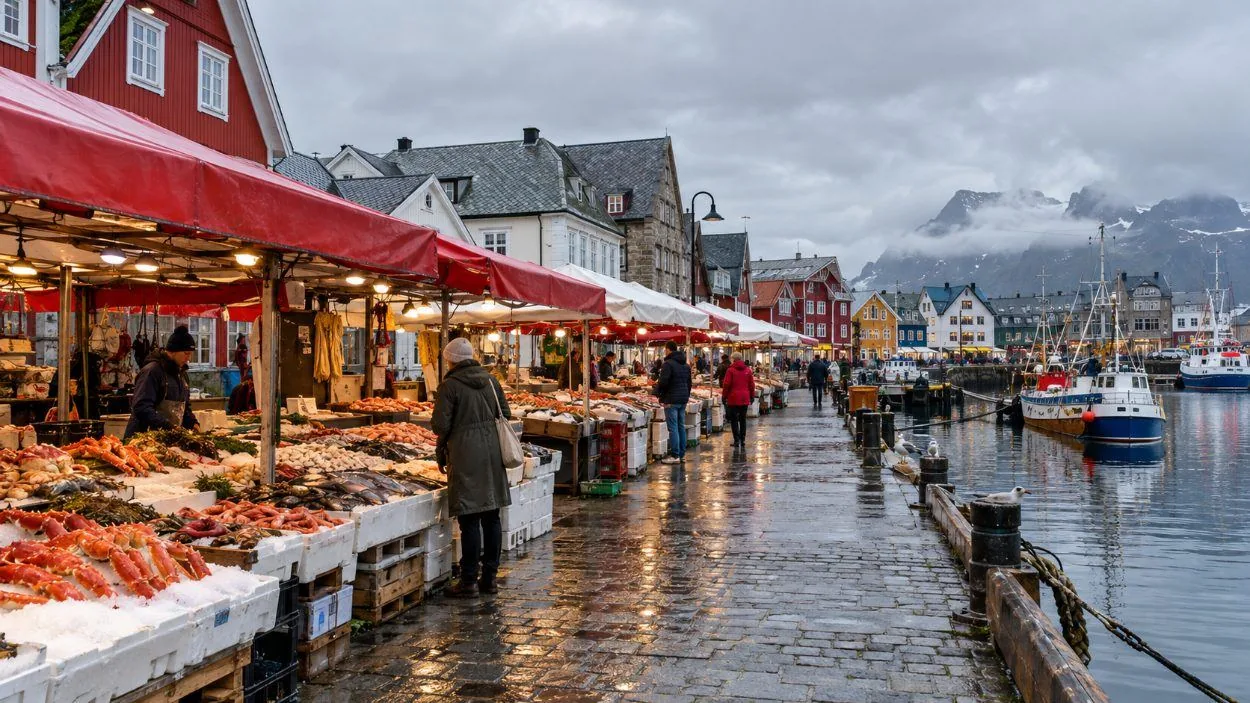
The other place is the Fish Market, and Norwegians argue about it openly. In 2013 Aftenposten ran the headline “Norges største turistfelle” — Norway’s biggest tourist trap — quoting the marketing professor and Bergen native Trond Blindheim, who called it overpriced and inauthentic and said locals went elsewhere for better seafood. Bergen’s tourism director at the time, Ole Warberg, defended it, pointing to a lack of customer complaints and rising visitor numbers. The argument still runs in the Bergen press. The Fish Market, both sides.
The tax-free refund scheme covers goods you carry out of the country, validated before check-in and exported within 30 days. Food you have already eaten and restaurant meals are not refundable, and residents of Sweden, Denmark and Finland are excluded entirely.
What a food tour does to the arithmetic
A food walk is one payment covering thirteen tastings across five venues, and on the flagship it also carries return Fløibanen funicular tickets, which you would otherwise buy separately. Whether that is good value depends on what you would have done instead, but it is at least a single decision rather than five. What a food tour covers · Eating cheaply in Bergen.
The live figure, for your own date
Choose your date and party size below to see what the walk costs on the day you want. It runs three and a half hours, takes in thirteen tastings across five venues, caps at eight people and includes return Fløibanen tickets.
Frequently asked questions
Is Bergen expensive to eat in?
Yes, particularly anything brought to a table: a sit-down dinner costs several times what the same meal costs in southern Europe. Groceries sit at a lower tax rate and the gap between the two is wider here than most visitors expect. Why food costs more in Norway.
How can I eat cheaply in Bergen?
Shift spending from table service to counters and shops, drink the tap water, and do not budget for tips, because none are expected. Bakeries and the indoor food hall at the Fish Market are the practical middle ground. Eating cheaply in Bergen.
Can I get a tax refund on restaurant meals in Norway?
No. The tax-free scheme covers goods you export within 30 days after validation at a refund counter, not food you have eaten or meals you have been served. Residents of Sweden, Denmark and Finland are excluded from the scheme. The tax structure, in words.